
Services
Loft conversions
Dormer, hip-to-gable, mansard, Velux.
Call 07768 056143Mon–Sat, 8am–6pm- Areas covered
- Rolvenden, Tenterden, Cranbrook, Hawkhurst, Biddenden & the wider Weald.
- Typical lead time
- 4-16 weeks from quote to start, depending on scope and consents.
- Trading since
- October 2002 · Companies House #04561027.
About this service
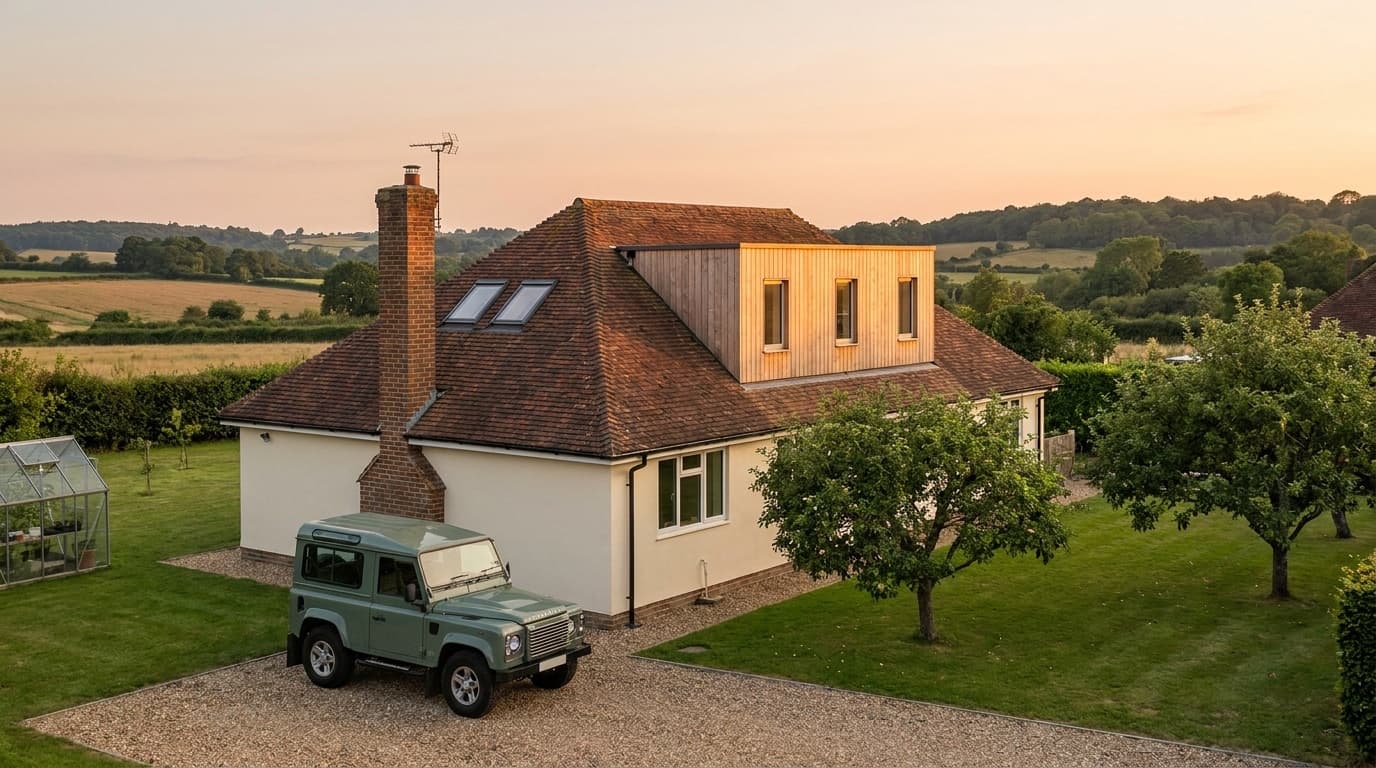
Loft conversions in cottages and modern homes alike, including dormer and hip-to-gable conversions navigating High Weald conservation rules.
Loft conversions, on cottages and on modern homes
About half the loft conversions we do are on Wealden cottages and farmhouses where the existing roof pitch is steep enough to give workable headroom with rooflights (or a discreet rear dormer); the other half are on the post-war and 1970s housing stock around Rolvenden, Hawkhurst and the edges of Tenterden where a dormer or hip-to-gable conversion adds a full master suite.
The conversion type that fits depends on roof structure, headroom under the existing ridge, planning constraints, and what you want the new space to do.
Type of conversion — when each fits
Velux (rooflight only) — cheapest and quickest. Works on roofs with at least 2.4m headroom under the ridge and enough plan area for a useful room. No planning permission required outside conservation areas (it's permitted development for most properties), but inside conservation areas a full application is usually needed for any roof alteration.
Dormer — adds usable floor area where the roof slope eats the headroom. Rear dormers in box, gable or mansard form are the most common; box dormers maximise space but are visually heavy, mansards are kinder to the elevation. Front dormers are routinely refused inside conservation areas.
Hip-to-gable — converts a hipped end into a gable wall, gaining significant width. Common on 1930s-70s semis and chalet bungalows. Conservation-area properties usually can't do this; outside the conservation lines it's often permitted development.
Mansard — fully reconfigures the roof to maximise volume. Sometimes the right answer on a Victorian terrace; rarely the right answer on a Wealden cottage, where it would dominate the original elevation.
High Weald and conservation context
Inside the High Weald National Landscape (which covers almost every village we work in), dormers must be subordinate to the original roof, set well below the ridge, and the cheek walls should be either tile-hung or weatherboarded to read as part of the building. Lead-clad cheeks are usually accepted on Victorian and Georgian properties; on later vernacular the answer is usually painted weatherboarding.
Article 4 directions in Tenterden and parts of Rolvenden remove permitted-development rights for roof alterations entirely — a full householder planning application is required for any visible change.
Building regulations and structure
Loft conversions trigger Building Regulations Part B (fire safety) — the staircase down to the floor below must be enclosed and protected to FD30 standard, and on three-storey houses the escape route gets stricter. Headroom over the staircase has to be at least 2m, which sometimes drives the dormer position. Floors usually need joist replacement or doubling (the existing ceiling joists are almost never structurally adequate for a habitable room), and the roof timbers often need stiffening to take the new loadings.
We bring in a structural engineer at quote stage on anything beyond a simple Velux — it's cheaper to know early what beams are needed than to discover it during strip-out.
Typical Weald budgets (2026)
Velux-only conversion with new floor, staircase, en-suite and decoration: £45,000-£75,000.
Rear box-dormer conversion adding a bedroom and en-suite: £65,000-£115,000.
Hip-to-gable with rear dormer, bedroom + en-suite + dressing: £95,000-£155,000.
Full mansard or two-bedroom dormer with structural roof rework: £130,000-£220,000.
How a loft project runs
Site visit and rough scope discussion. Engagement of a structural engineer if needed for a feasibility note. Quote against either your architect's drawings or against a brief if you don't have drawings yet. Planning application (eight weeks for householder applications) where required. Once approved, building regulations submission, scaffold up, work proceeds in eight to fourteen weeks on site depending on type.
Recent loft conversions
Examples from across the Weald.
Planning a project?
Let's talk about what you're building.
Tell us about your project — extension, refurb, listed-building work, new build, anything in between. We'll come and have a look, talk it through, and put together a quote.